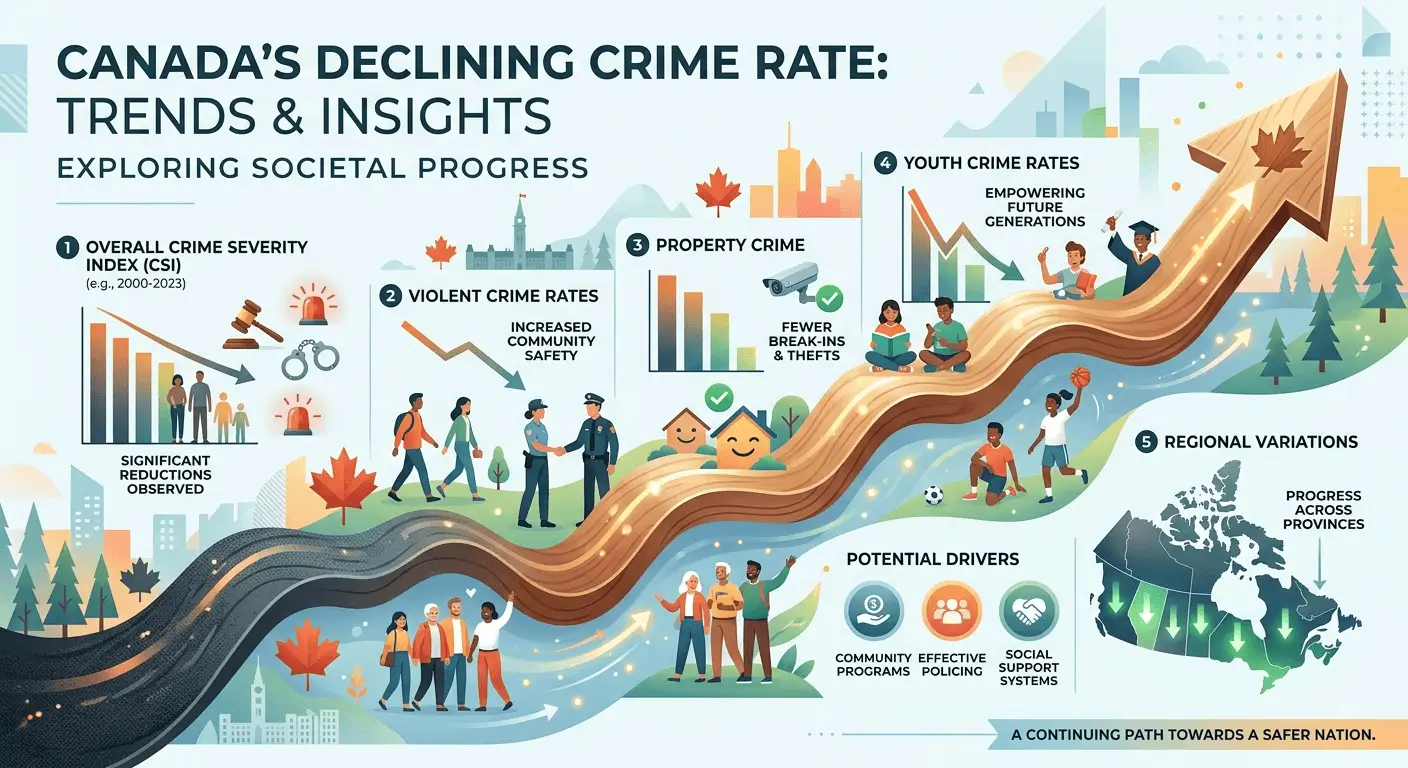
Canada's Declining Crime Rate:
Short Description : -
Understanding the 2025 Crime Statistics and the Challenges That Remain
Full Description : -
Statistics Canada's release of the 2025
national crime statistics provides encouraging evidence that Canada is
experiencing a measurable decline in both the volume and severity of
police-reported crime. For the second consecutive year, the Crime Severity
Index (CSI) declined, falling by five percent, while the conventional crime
rate decreased by two percent. Perhaps most notable was a 16 percent reduction
in the homicide rate—the largest annual decline since 1986—bringing Canada's
homicide rate to its lowest level since 2014.
These findings represent positive news for
Canadians and reflect progress in several key areas of public safety. However,
as with any crime statistics, they must be interpreted carefully. Crime trends
are complex, influenced by numerous social, economic, legislative, and
technological factors. Moreover, police-reported crime statistics provide only
one measure of crime and should not be viewed as a complete representation of
criminal activity in Canada.
Understanding the Crime Severity
Index
Public discussions frequently focus on the
overall crime rate. While useful, the traditional crime rate treats every
criminal offence equally, regardless of its seriousness. A minor theft is
counted the same as a homicide.
The Crime Severity Index provides a more
sophisticated measure because it incorporates both the frequency of crime and
the seriousness of each offence. Serious violent offences receive substantially
greater weight than less serious property offences. Consequently, the CSI
offers a more meaningful assessment of changes in public safety over time.
The five percent decline in the Crime
Severity Index therefore suggests not only that fewer crimes were reported but
also that the most serious offences declined at a greater rate than less
serious crimes. From a criminological perspective, this represents a
significant improvement in community safety.
Positive Trends Across Canada
Several crime categories demonstrated
notable improvements during 2025.
The reduction in homicides stands out as
particularly significant. Homicide remains one of the most reliable indicators
of violent crime because it is almost always reported to police. The 16 percent
decline recorded in 2025 is therefore unlikely to be explained by reporting
practices and instead reflects a genuine reduction in lethal violence.
Property crime also continued its downward
trajectory. Break-and-enter offences declined by 11 percent for the third
consecutive year, while motor vehicle theft continued to fall after reaching
historic highs in recent years. Canada's auto theft rate now sits substantially
below its 2023 peak.
Collectively, these trends suggest that
both violent and property crime prevention efforts are producing measurable
results.
Why Might Crime Be Declining?
No single factor explains changes in
national crime rates. Crime trends emerge from the interaction of numerous
variables operating simultaneously.
One likely contributor is the continued
evolution of intelligence-led policing. Canadian police services increasingly
rely on crime analysis, predictive deployment strategies, forensic
intelligence, automatic licence plate recognition, surveillance technology, and
enhanced information sharing among municipal, provincial, federal, and
international policing partners. These approaches allow law enforcement
agencies to identify patterns of offending, target repeat offenders, and
disrupt organized criminal networks more effectively than traditional reactive
policing models.
Targeted enforcement against organized
auto theft provides one example. Greater collaboration between domestic police
agencies, border authorities, and international partners appears to have
contributed to the continued reduction in vehicle thefts.
Technological improvements among the
public may also be influencing crime rates. The widespread adoption of smart
home security systems, video doorbells, vehicle tracking technology,
neighbourhood surveillance cameras, and improved environmental design has
increased the perceived risk of detection for many offenders. Crime prevention
through environmental design (CPTED) research has consistently demonstrated
that increasing guardianship and reducing criminal opportunities can lower
offending rates.
Broader social conditions may also be
contributing to declining crime. Research has long established relationships
between crime and factors such as employment opportunities, educational
attainment, youth engagement, housing stability, substance use treatment, and
mental health services. Investments in prevention and community development
frequently yield long-term reductions in criminal behaviour by addressing the
underlying social conditions associated with offending.
Legislative changes may also play a role.
In 2025, Parliament introduced amendments that strengthened bail provisions for
certain offences, created new Criminal Code offences, and restored selected
mandatory minimum penalties.
However, it is important to exercise
caution before attributing declining crime directly to these legislative
reforms. Criminal justice policies often require several years before
measurable effects become evident in national statistics. Sound criminological
analysis requires longitudinal research rather than immediate conclusions based
on short-term trends.
Crime Is Not Declining Equally Across
All Categories
Although the overall trends are
encouraging, several categories of crime continue to present significant public
safety challenges.
Shoplifting increased for the fifth
consecutive year, rising another 11 percent during 2025. Several factors likely
contribute to this trend. Persistent inflation and increased living costs have
created financial pressures for some households. Simultaneously, expanded
reliance on self-checkout systems has created additional opportunities for
theft. Organized retail crime has also become increasingly sophisticated, with
criminal groups stealing merchandise for resale through online marketplaces.
Fraud presents an equally concerning
picture. Although fraud declined slightly in 2025, reported fraud remains 61
percent higher than it was a decade ago. Contemporary fraud increasingly
involves sophisticated international criminal networks utilizing artificial
intelligence, cryptocurrency, spoofed communications, phishing campaigns,
romance scams, investment fraud, and identity theft. These offences frequently
transcend national borders, creating substantial investigative challenges for
Canadian law enforcement agencies.
Hate crime trends similarly require
careful interpretation. While total reported hate crimes declined modestly,
offences targeting newcomers to Canada, persons with disabilities, and
individuals targeted because of their sex or gender increased. These findings
suggest that while progress has been achieved in certain areas, prejudice and
discrimination continue to evolve in ways that require ongoing attention from
policymakers, law enforcement agencies, educators, and community organizations.
Statistics Canada also noted continuing
concerns surrounding child sexual abuse and exploitation material. Although
reported incidents declined, the agency cautioned that these offences remain
significantly underreported. Moreover, advances in generative artificial
intelligence have created new investigative challenges by enabling offenders to
produce synthetic exploitation material at unprecedented speed and scale.
Interpreting Crime Statistics
Responsibly
While the 2025 statistics are encouraging,
they should not be interpreted as evidence that crime has been
"solved."
Police-reported crime statistics measure
only incidents that come to the attention of law enforcement. Many
offences—including sexual violence, intimate partner violence, elder abuse,
fraud, cybercrime, and certain hate incidents—remain substantially underreported.
Victimization surveys consistently demonstrate that official crime statistics
represent only part of the broader crime landscape.
Similarly, national averages can obscure
important regional differences. Although most provinces, territories, and
municipalities experienced improvements during 2025, crime patterns remain
highly localized. Communities continue to face unique challenges related to
organized crime, gang activity, addictions, rural crime, cybercrime, repeat
offending, and social disorder. Effective crime prevention therefore requires
locally tailored responses supported by national policy.
Finally, crime trends are inherently
cyclical. Canadian history demonstrates periods of increasing and decreasing
crime over several decades. Two consecutive years of declining crime represent
an encouraging development but should not be interpreted as a permanent
trajectory. Sustaining these gains will require continued investment and
vigilance.
Maintaining Canada's Progress
The 2025 crime statistics provide an
opportunity not only to celebrate progress but also to identify priorities for
the future.
Governments should continue investing in
evidence-based crime prevention strategies that address the root causes of
offending. Research consistently demonstrates that investments in early
childhood development, education, youth engagement, addiction treatment, mental
health services, housing stability, and employment opportunities reduce
criminal behaviour more effectively than relying exclusively on punitive
responses after offences have occurred.
Police services must continue adapting to
rapidly evolving criminal environments. Cybercrime, fraud, financial crime,
artificial intelligence, organized crime, and online child exploitation
increasingly require specialized investigative expertise, digital forensic
capacity, intelligence-led policing, and strengthened international
partnerships.
Governments should also continue
evaluating bail reform, sentencing policy, and criminal justice legislation
using empirical evidence rather than political rhetoric. Public confidence in
the justice system depends upon policies that enhance public safety while
remaining consistent with constitutional principles and the rule of law.
Equally important is the need for stronger
collaboration among police services, governments, schools, social service
agencies, community organizations, financial institutions, and technology
companies. Crime prevention is not solely a policing responsibility; it is a
shared societal responsibility requiring coordinated action across multiple
sectors.
Finally, public education remains one of
Canada's most underutilized crime prevention tools. Increasing public awareness
regarding fraud prevention, cybersecurity, online safety, hate crime reporting,
and digital literacy can substantially reduce victimization and improve
community resilience.
Conclusion
Statistics Canada's 2025 crime data
provide cautious optimism. Canada appears to be experiencing meaningful
reductions in serious violent crime and many forms of property crime. At the
same time, emerging threats—including cyber-enabled fraud, organized retail
crime, artificial intelligence-assisted offending, and evolving patterns of
hate crime—illustrate that the nature of crime continues to change.
The lesson is clear: effective crime
prevention requires continuous adaptation. Progress should be acknowledged, but
it should never lead to complacency. Sustaining safer communities will depend
upon evidence-based policing, informed public policy, continued investment in
prevention, technological innovation, and strong partnerships among
governments, law enforcement agencies, community organizations, and the public.
Ultimately, the most successful criminal
justice system is not measured by the number of arrests it makes, but by the
number of crimes that never occur because effective prevention, sound policy,
and resilient communities have reduced the opportunity and motivation to
offend.



Comments (0)
No comments yet. Be the first to comment!